An ordinary kettle never measures the water's temperature. So what tells it to stop? Picture a kettle cut in half and coming to the boil. Watch the handle. Then comes the click.
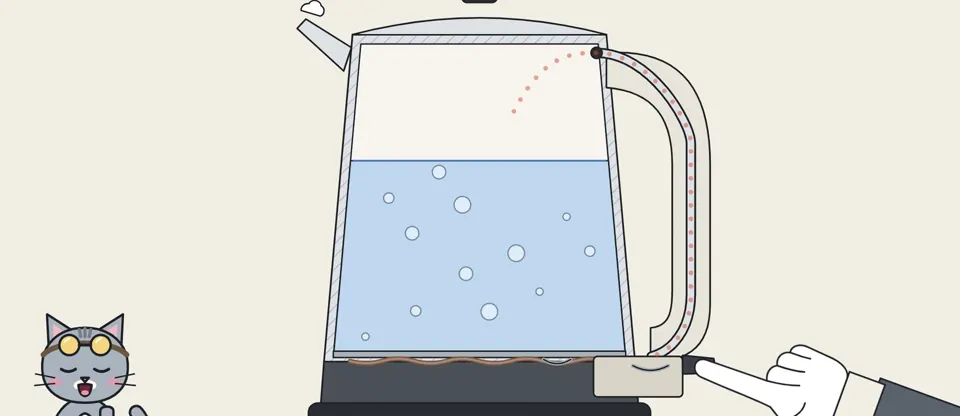
That click hides four questions: why the kettle does not just measure the water, what the click is, how it knows the water is boiling, and what happens if there is no water at all.
Kettles did not always stop. Before 1955, an electric kettle left on could keep going until it boiled dry. At best, that wrecked it. At worst, it started a fire. Then a British firm, Russell Hobbs, sold the K1, the first kettle that switched itself off. Its successor was advertised as the Forgettle. In the 1970s, an engineer called John Taylor invented a small metal part for kettle switches. He says over two billion have been made, and one may well be in your kitchen.
A thermometer?
What tells a kettle to stop: the water reaching a hundred degrees, a timer, or something else? Pick one before you read on.
Surely there is a thermometer in there? Build that kettle: a probe in the water, and a switch set to trip at a hundred degrees. It looks perfect, until you carry it up a mountain. For every hundred and fifty metres you climb, water boils about half a degree cooler. Sixteen hundred metres up, it boils at about ninety-five degrees. Boiling water cannot get any hotter, so the probe never reads a hundred, and this kettle never stops.
Go the other way, down to the Dead Sea, where water boils a little hotter. The engineering magazine Ingenia makes the point: a kettle set to stop at a hundred would switch off there before the water boils. A timer is no better. It cannot tell one cup from a full jug.
The kettle must sense the boil, and only the boil.
The disc that snaps
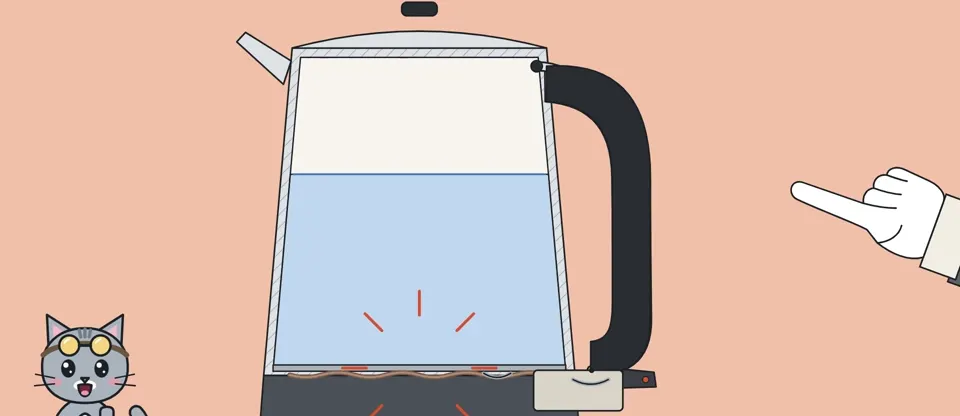
At the bottom of the kettle, under the water, is the element, a flat plate that heats. A thin steam tube runs up inside the handle and opens above the water. At its foot, behind the switch, sits a small round disc made of two different metals bonded together. Heat makes metal grow, just a little, and one metal grows more than the other. Bonded, they cannot slide apart, so the pair bends.
A disc that bends slowly would creep, with no clear moment to cut the power. So it is pressed into a shallow dome. Think of the button on a jam-jar lid: push, push, then pop. The disc does that with heat. It strains, then flips inside out at one set temperature.
Heat bends the dome until it snaps. The jam-jar lid needs your thumb. The disc needs only heat.
When the dome flips, it pushes up a lever. The lever opens the two contacts that carry the current, the element stops heating, and your switch jumps up. That click is the disc snapping inside out, and the lever it trips.
The steam path
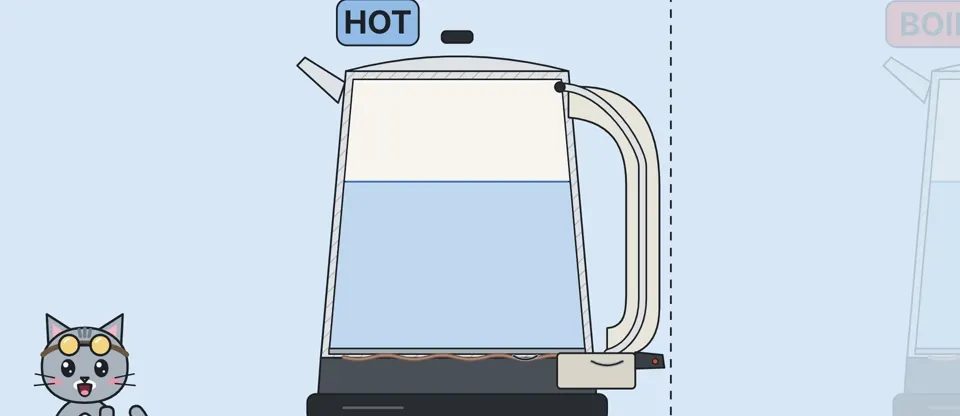
Why does the disc not snap early, while the water is only hot? Halfway to the boil, the water is warm but not boiling, and only a little damp air drifts into the tube. The disc sits warm, well below its snap point. Nothing happens, and that is the point.
Now let it boil. Steam bursts through the water and up to the top, and it has to go somewhere. One way out is down the tube. It floods onto the disc, which in a few seconds goes from warm to nearly a hundred degrees.
The kettle never measures the water. It waits for steam.
That is how. The snap point is set well below a hundred degrees, so warm water cannot flip the disc. Only a flood of steam heats it fast enough, and that flood comes only at the boil. At sea level, that is a hundred degrees. Sixteen hundred metres up, it is ninety-five.
So the real answer was the third guess: steam. Russell Hobbs used it in 1955. One history of its early kettles says that steam, forced through an opening in the lid to a strip of two metals at the back, knocked the switch off. That is the Forgettle: you could forget it, because it switched itself off.
No steam
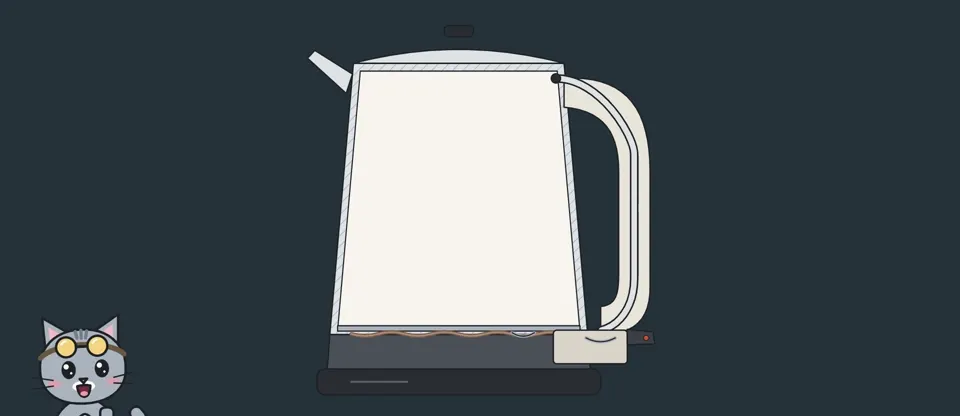
What if there is no water at all? The element heats up fast, but no water means no boil, and no steam. So the disc never feels a thing. That is why most kettles carry a second disc, pressed against the element. With water in, the water carries the heat away and this disc stays cool. Run it dry, and the element overheats until this disc snaps too.
The second disc trips on the element's heat, not on steam.
The first disc also explains a kettle that will not stop. Leave the lid open, and steam escapes instead of going down the tube. Limescale can block the tube's opening, and overfilling can let water into it. Each time, the disc waits for steam that never comes. So if yours keeps boiling, switch it off, unplug it, check the lid and the fill level, and descale it.
Try it
Can you check this at home? Yes, with a clock and your ears.
Fill exactly one litre from the cold tap and time it to the boil. Heating it from about twenty degrees takes about 335,000 joules. Divide that by your kettle's watts, printed on its base, since a watt is one joule every second. At 3,000 watts, the fastest time is about two minutes. Listen at the end: the water roars at a full boil for a few seconds before the click. The click comes after the roar, not at a fixed temperature.
Quick check
Take your kettle to a cabin sixteen hundred metres up, where water boils at ninety-five degrees. Does it still switch itself off? It does. The water still boils, so steam still floods the tube, and the disc snaps well below a hundred. If you said no, that was the thermometer kettle talking.
In one breath
An ordinary kettle never measures the water. It waits for steam, and a dome of two bonded metals snaps when the steam floods the tube, cutting the power. With no water in it, a second disc trips on the element's heat instead.