A pen is full of ink, and its tip has a hole in it. So why doesn't the ink drip out? And how does it write the moment it touches paper?
Inside the tip, a tiny ball sits in that hole. It is about one millimetre across, and as you write, it rolls.
The first ball pen
In 1888, an American named John Loud got a patent for a pen with a ball at its tip. He made it for marking rough things, like wood and wrapping paper. The story goes that it worked on wood and leather. But it was too rough for writing paper.
More than fifty years later, a Hungarian newspaper man named László Bíró tried again. His patent in Argentina was filed in 1943. He used a thick ink, much thicker than fountain pen ink.
Guess
Stand a pen in a cup, tip down, for one hour. Does it: A, drip ink into a puddle; B, drip nothing at all; or C, dry out so it never writes again? Pick one now.
Like a tap?
Many people think a pen works like a tap. The ink falls down and drips out of the tip. Gravity does pull the ink down, but only inside the pen, to the ball. It cannot pull the ink out past the ball. So the answer is B. After an hour, nothing has dripped, and the pen still writes after a quick scribble. So C is wrong too.
The parts
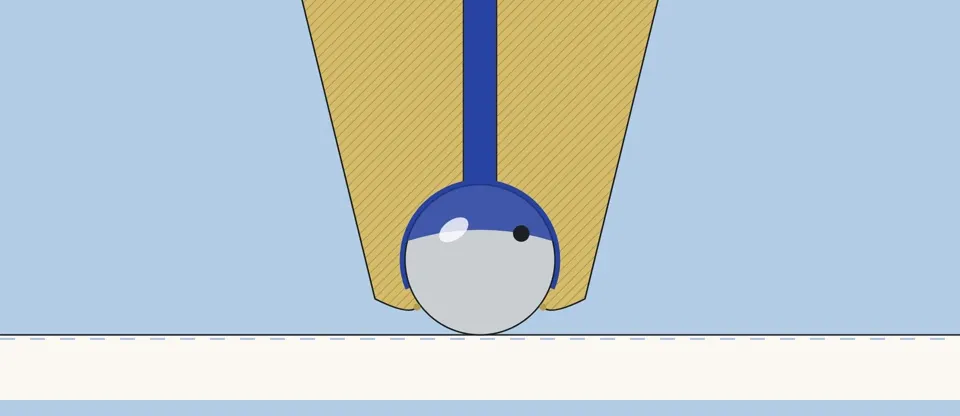
So what stops it? The ball is very hard metal, about one millimetre across. It sits in a cup of metal called the socket. At the very tip, the metal edge is bent inwards, like a lip. The lip is narrower than the ball, so the ball cannot fall out.
Above the ball, a thin channel carries ink down from the ink tube.
A lid
The ball fits its socket very closely. The gap is only a few thousandths of a millimetre. A drawing has to show it much wider, so you can see it at all.
That gap is small enough to hold thick ink back. The ball sits in the hole like a plug, with almost no room around it.
The ball doesn't just roll. It also works like a lid, plugging the hole the way a cork plugs a bottle.
Thick ink
A tight lid is not the whole answer. The other half is the ink. Put a drop of water on a plate, and it spreads out flat. Put a drop of pen ink next to it, and it stays in a thick blob. Pen ink is a thick paste, thousands of times thicker than water.
Why not use a runny ink? It would flow more easily. But a thin, runny ink could ooze through a gap that small. So pen ink is kept thick, and that is why Bíró's thick ink mattered. Two things keep the ink in: a lid that plugs the hole, and a thick ink that won't run.
Ink out
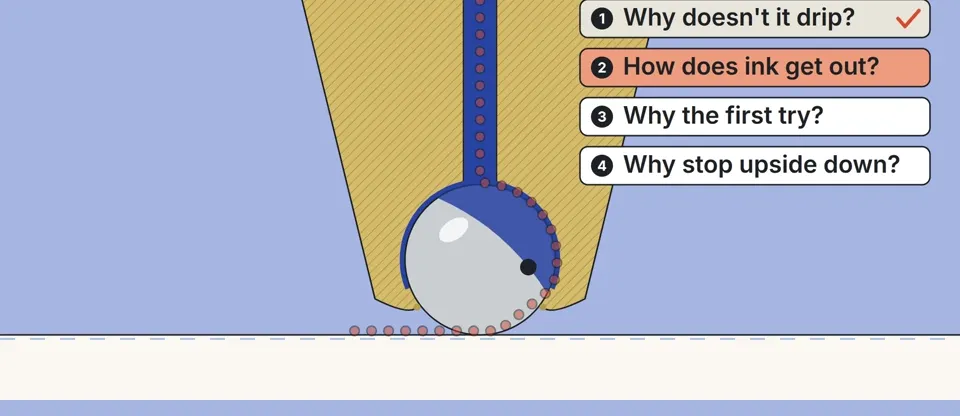
But if nothing drips, how does the ink get onto the paper? Hold the pen still, and hardly any ink comes out. Now move the pen. The paper rubs on the ball, and the ball starts to turn. As it turns, the back of the ball picks up a thin coat of ink and rolls it round to the front.
The ink does not fall out. The paper turns the ball, and the turning ball carries the ink out.
It works like a paint roller, but this ball never needs dipping, because its back sits in the ink.
The air hole
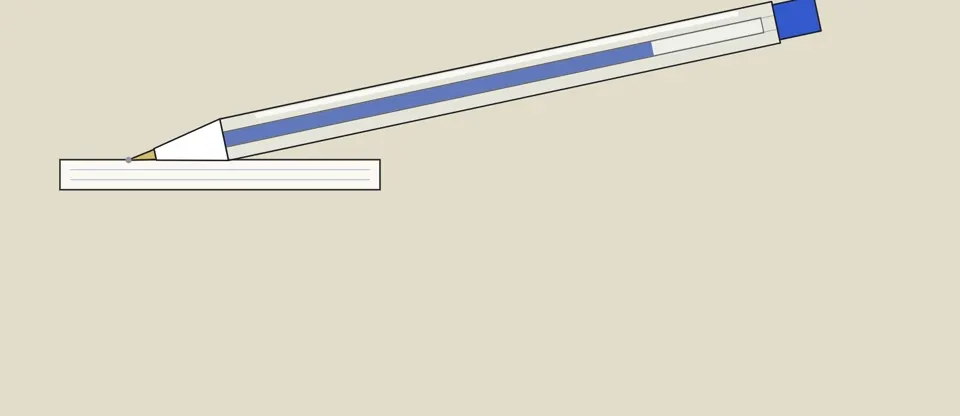
Every time you write, a little ink leaves the tube. Something has to take its place. Otherwise an empty space would form behind the ink and pull it back, and the ink would stop flowing. So there is a tiny hole that lets air in behind the ink.
On a Bic Cristal, you can see it on the side of the pen's clear body. The ball rolls the ink out, and air fills the space behind it.
First try
So why does it write the very first time? The back of the ball sits in ink, even while the pen lies in a drawer. It is already wet.
The back of the ball sits in ink, even at rest, so it writes at once. One small turn, and the wet side comes round to the paper.
That is why you usually don't have to pump the pen, or shake it. You just write.
Skips
Some pens skip at first. Sometimes the ink at the tip dries. Or a bubble of air gets in the way. In 1946, an early pen company reported a small air bubble in the barrel. It sometimes kept the ink from flowing freely to the ball.
Whether the ink dried or a bubble is in the way, the ball turns, but nothing wet comes round. That is why a quick scribble helps.
Upside down
Here is a check. Tape paper above you, and write with the pen pointing up until the line fades. Was the ink used up, did it slide back away from the ball, or did the ball fall into the pen?
The answer is the second one. With the tip up, gravity pulls the ink down the tube, away from the ball. So the ball runs dry. It is not empty, and the ball did not fall in. Turn the pen over, and it writes again.
In space
Upside down, a pen stops writing. Except in space. In 2003, the astronaut Pedro Duque wrote his notes in space with a cheap ballpoint. He had been told that normal pens do not work in space. His did.
Most likely, nothing pulls the ink away from the ball up there, so the ball stays wet. You may have heard that NASA paid millions to invent the space pen. It didn't. The Fisher pen company paid for it, with its own money.
Try it
Tape a sheet of paper under a table. Lie on the floor beneath it, and do not climb on anything. Write your name with a cheap pen, pointing up, until the line fades. Then turn the tip down, scribble on a scrap of paper, and write again.
It should work. The pen was not empty. The ink had just slid away from the ball.
In one breath
A ballpoint pen does not pour ink. A tiny ball plugs the tip like a lid, and thick ink stays put until the paper turns the ball and carries a thin coat out. The back of the ball sits in ink, so the first turn writes, and the ink slides away when you write upside down.