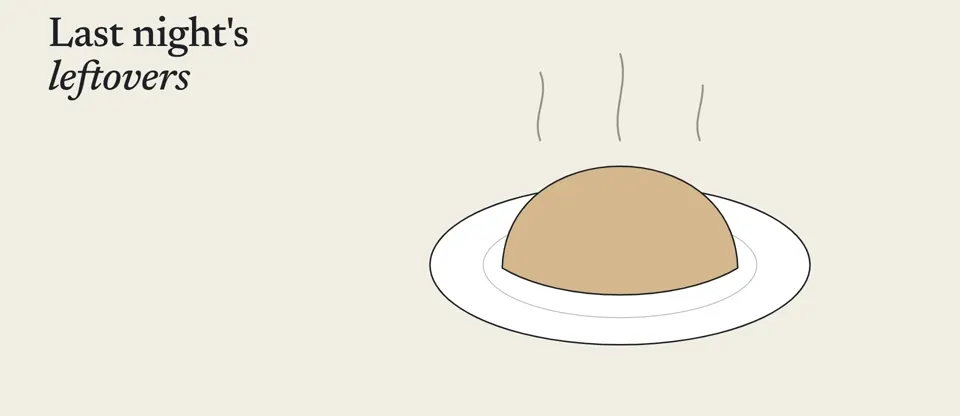
You heat up last night's leftovers. A couple of minutes later, the edge is scalding, and the middle is still cold.
There is no flame in there and no hot plate. There is just a metal box that hums. So what is actually heating your food? Once you see it, you will know how to heat leftovers evenly.
When a microwave heats a bowl of soup, where does the heat start? In the centre, in the outer layer, or everywhere at once? Pick one before you read on.
You have probably heard that microwaves cook food from the inside out. It feels right. There is no hot surface, and the heat seems to come from nowhere. But if it were true, the middle would be the hottest part. Your leftovers say the opposite.
Making the waves
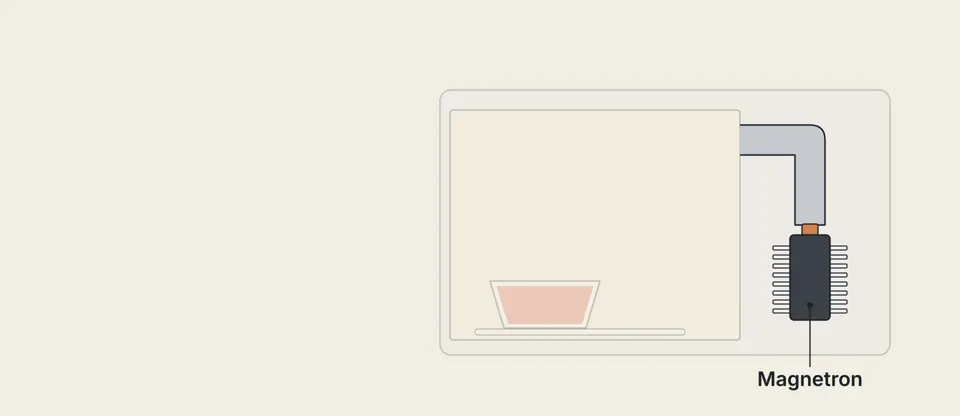
Open one up and you find a few main parts. The magnetron makes the waves. A short metal pipe, the waveguide, carries them out. They fill the cavity, the metal box your food sits in. The food turns on the turntable.
The magnetron turns electricity into microwaves, a kind of radio wave. Their electric field swings back and forth 2.45 billion times every second. One full wave is about twelve centimetres long.
The waveguide steers the waves into the cavity. Metal reflects microwaves, so they bounce from wall to wall instead of escaping. Even the door has metal in it: a mesh full of tiny holes. The holes are far smaller than the waves, so the waves cannot get out. Light can, so you can still see your food.
A wave bouncing around a box is not heat yet.
Why water heats
Zoom into the soup. It is full of water, and a water molecule is lopsided. Its oxygen end carries a slight negative charge. Its two hydrogen ends carry a slight positive charge.
The wave's electric field pulls on those charges. It tugs each molecule to turn and line up with it. Then the field reverses and tugs it back the other way, billions of times a second.
But the molecule is not alone. Its neighbours hold on to it, so it cannot quite keep up. It lags behind the field, and that lag turns the wave's energy into jiggling. Salt joins in too. Its charged pieces get pushed back and forth, and bump into their neighbours.
So the waves heat food by shaking its water, wherever they arrive. That brings us back to the big question: where do they arrive?
The lag between a water molecule and the field turns the wave's energy into jiggling. Jiggling molecules are what heat is.
How deep the waves go

Picture the soup cut in half. The waves arrive from every side. Every layer of water they pass through takes some of their energy, so the waves get weaker as they go deeper.
In wet food, about two thirds of their power is gone within a centimetre. In plain water, that happens within about one and a half centimetres. Only dry, airy food like bread lets them reach two to five centimetres. That is why a thick dish takes so long to heat through.
So the waves heat only the outer layer. The middle warms the slow way: heat creeps inward from that layer, molecule to molecule. That is called conduction. Microwaves do not cook from the inside out. They cook from the outside in.
Why not use the frequency water soaks up best? Water absorbs most strongly at around twenty gigahertz, about eight times higher than the microwave's frequency. At that frequency, the waves would be used up right at the surface. You would get a burnt skin and a cold middle.
Another popular claim is wrong. 2.45 gigahertz is not water's resonant frequency. It is a radio band the world set aside for machines like this one, and it is low enough that the waves get a centimetre or two into your food.
2.45 gigahertz is not water's favourite frequency. It is a radio band set aside for machines like this one.
Use it
Now you can explain the instructions on every ready meal. Stir halfway, which moves the cold middle out to where the waves can reach it. Let it stand, which gives conduction time to even out the heat. Spread it out in a wide, shallow dish too. The thinner the food, the less middle the heat has to reach.
Here is a quick check. Why does your microwave have a turntable? Because the bouncing waves leave fixed hot and cold spots. If the food sat still, it would overheat in some spots and stay cold in others. Turning carries the food through those spots, so no part stays in one place.
Tell someone at dinner, in four lines. The magnetron makes the microwaves, and the metal box traps them. The waves twist water molecules back and forth, and that jostling is heat. The waves are used up in the outer centimetre or two. Conduction carries the heat to the middle, so stir it and let it stand.
In one breath
Microwaves do not heat food from the inside out. The magnetron makes waves, the metal box traps them, and they shake the water in the outer centimetre or two of your food. Conduction carries that heat to the middle, and that is why your leftovers were scalding at the edge and cold in the middle.