This pan of water is boiling, but nothing under it is burning. There is no flame, and no red-hot ring. It is an induction stove, and the pan heats itself.
Under the black glass, something is moving. You cannot see it, and you cannot feel it. But it reaches the pan.
Moreland's range
In the early 1970s, the company Westinghouse built one of the first home induction stoves. In 1973, one of its engineers, William Moreland, wrote a paper about it.
He said the way it heats a pan is simple. The pan gets heated directly. The top of the stove does not get heated first. So the heat does not start under the pan. It starts inside the pan.
Guess
Three pots sit on an induction stove, all switched on at full power: one cast iron, one thick aluminium, and one glass. Does it: A, get all three hot; B, heat only the cast iron; or C, heat the cast iron and the aluminium? Pick one now.
A hot ring?
Most of us picture a hot ring hidden under the glass. It glows, it heats the glass, and the glass heats the pan. Some glass stoves really do work like that. But not this one.
Take the pan away, and switch the stove on. Nothing happens. The stove does not even start. Put the pan back, and it boils. Lift the pan off, and the stove stops heating it at once. A hot ring would not care whether a pan was there. This stove only heats when a pan is sitting on it.
Under the glass
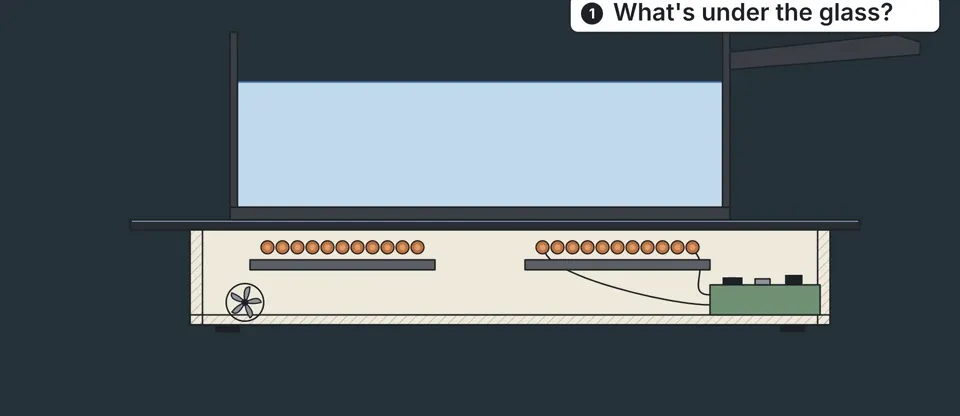
Lift the glass top away, and right under it is a flat coil of copper wire, wound round and round like a snail shell. Below the coil is a box of electronics, with a fan to keep them cool. The electronics send electric current through the coil.
The glass is just a lid. It keeps food and water off the coil. The current in the coil does not flow one way. It keeps changing direction. Any current in a coil makes a magnetic field around it, so this coil makes a field that keeps changing direction too. It swings back and forth about twenty-five to fifty thousand times every second.
The pan heats itself
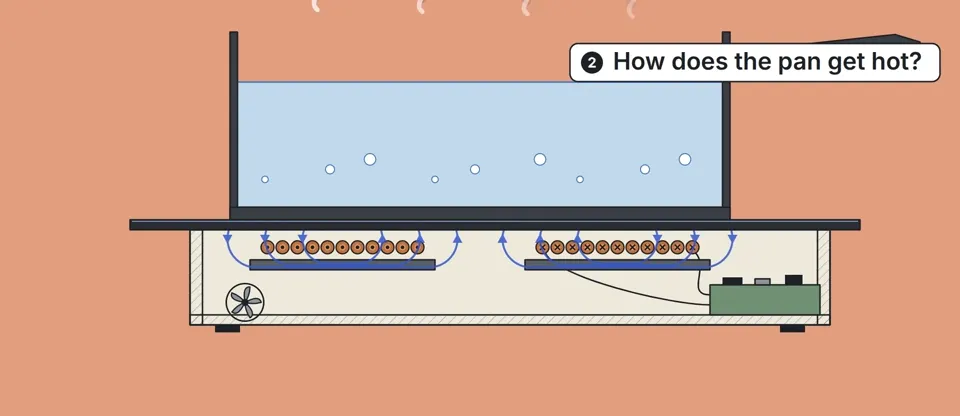
So how does the pan get hot? When a changing field passes through metal, the field pushes electric current round inside that metal, in circles.
Why does that make heat? Metal does not let current through for free. It pushes back a little, and that push back turns into heat.
The field pushes current round in the pan's metal, and the metal turns it into heat.
The pan's base is like the wire in a toaster. Current runs through the wire, and the wire gets hot. But a toaster wire is plugged in, and nothing is plugged into the pan. No wire touches it at all. It just sits on the glass.
The field reaches through the glass and pushes the current for you. So the stove does not make the heat that cooks your food. The pan is the heater. The hot base then heats the water, the same way any hot pan does.
Which pans
Why do only some pans work? Think of the aluminium pot from the guess. Aluminium spreads heat really well, so surely it would heat best of all? Switch it on. It barely warms up. Many stoves will not even start, because they can tell it is the wrong kind of pan.
The difference is magnetism. A fridge magnet sticks to iron, but it does not stick to aluminium or copper. In iron and steel, the field squeezes the current into a very thin layer at the bottom. In steel, it is about a tenth of a millimetre thick. All the current crowds into that thin layer, so it makes a lot of heat. In aluminium, the current spreads into a thicker layer, and makes much less heat.
On most stoves, only a pan a magnet sticks to heats well.
So back to the guess. The cast iron gets hot. The aluminium barely warms, or the stove won't start. And the glass pot is not metal at all. No current can flow in it, so it stays cold. The answer is B: only the cast iron gets hot. If you picked C, that makes sense, since aluminium is a metal and is great on a gas flame.
Cool glass
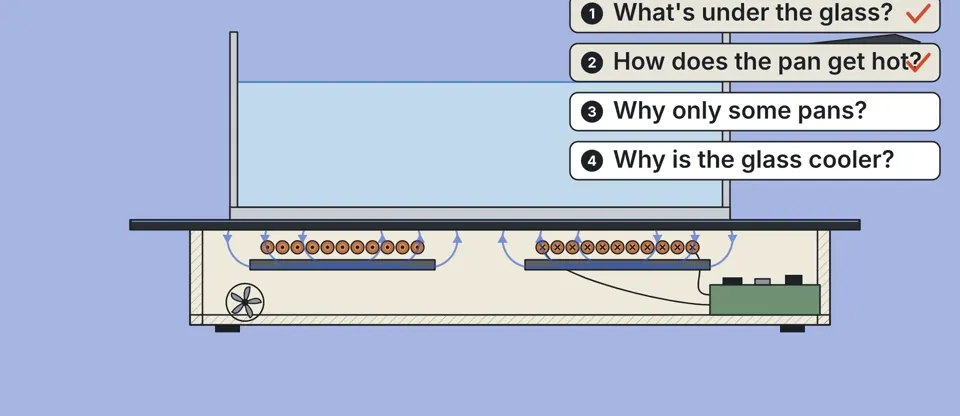
Why does the glass stay cooler than the pan? The field goes through the glass too. But glass is not metal, and no current can flow in it. With no current, there is no heat. The field passes through the glass without heating it. The metal pan is what heats.
The field passes through the glass without heating it, and the metal pan is what heats.
That does not mean the glass stays cold. Cook for ten minutes, then lift the pan. The glass under it is hot, and it came from the pan. So the glass can still burn you after cooking. That is why many stoves light up a warning until the glass cools down.
Check
Here is a check. The stove has just been switched off, and the pan has been lifted away. But the round patch of glass where the pan sat is still hot. Where did that heat come from: the coil, the magnetic field, or the pan that was sitting on it?
The answer is the pan. The coil is not a hot ring, and the field cannot push current through glass. So the field only heated the pan.
Here is an odd worry from an old patent. In 1974, a Westinghouse patent warned about spoons and forks. A spoon left on the stove is metal, so the field could heat it. So the stove checks for a pan before it switches on, and a spoon or fork does not count.
Try it
Keep the stove off, and use cold pans. Hold a fridge magnet to the bottom of each one. If it sticks firmly, the pan will usually work. If it barely sticks, or falls off, it probably won't.
In US government tests, each kind of stove was set to full power. Induction heated the water in a test pot to ninety degrees Celsius in about three minutes. Stoves with electric coils or glowing rings took six to nine minutes. Gas took fifteen to seventeen minutes.
In one breath
Nothing under an induction pan is burning. A coil makes a field that swings back and forth thousands of times a second, and the field pushes current round in the pan's own metal, so the pan is the heater. Only metal that a magnet sticks to heats well, and the glass only warms from the pan.